
About the Journal

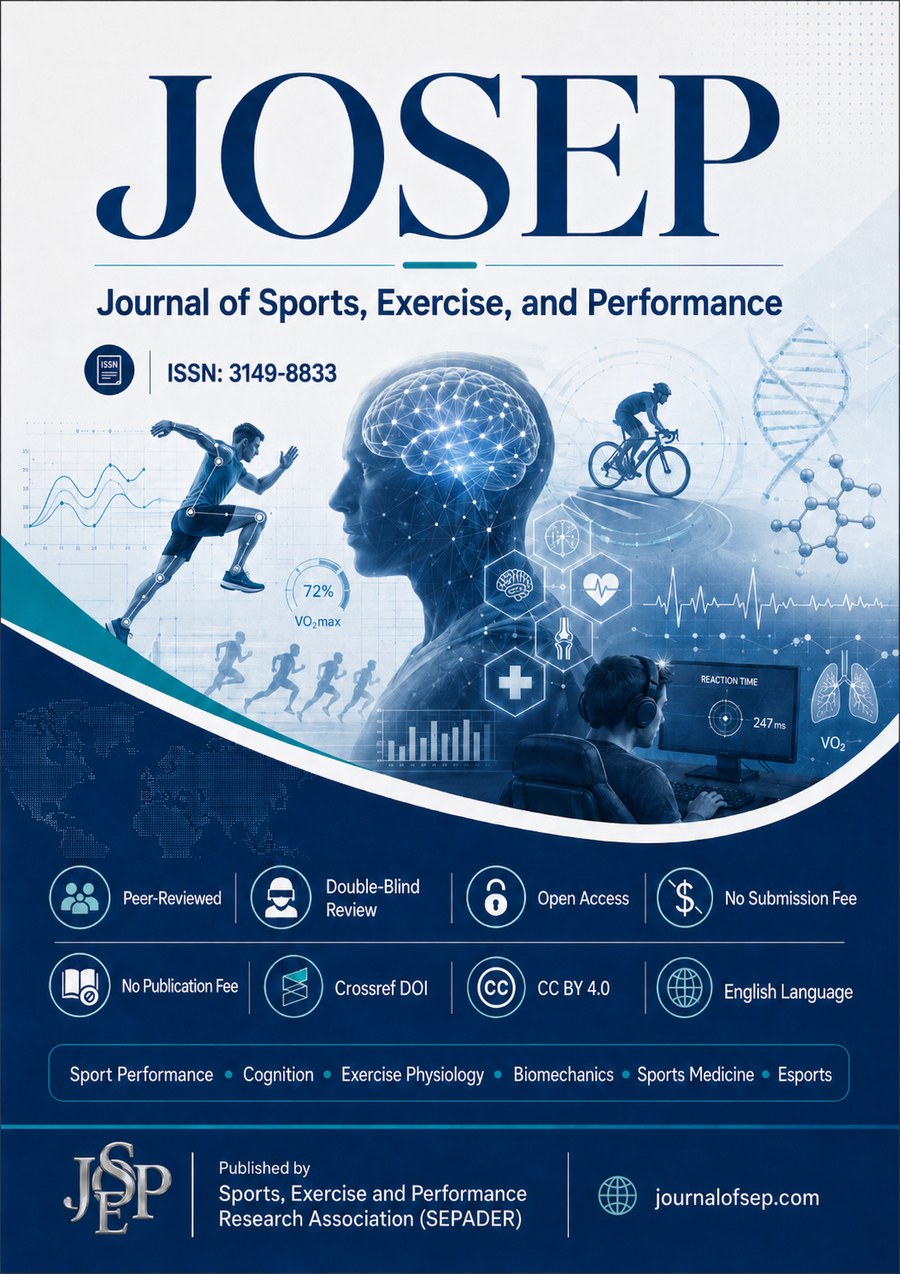
JOSEP Cover
Journal of Sports, Exercise, and Performance
International Peer-Reviewed Open Access Journal

The Journal of Sports, Exercise, and Performance (JOSEP) publishes original research and comprehensive reviews in exercise physiology, sports science, physical and cognitive performance, sports psychology, esports, and related interdisciplinary fields.

JOSEP aims to support high-quality, open-access scholarly communication through a transparent editorial process and a publication platform dedicated to advancing knowledge in sport, exercise, and human performance.

Double-Blind Peer Review
Manuscripts are evaluated through an impartial peer-review process designed to support scientific quality and editorial integrity.
Global Open Access
Published articles are freely accessible to readers worldwide, supporting visibility, dissemination, and academic impact.
Efficient Editorial Process
JOSEP aims to provide a clear and timely editorial workflow from submission to publication.
Interdisciplinary Scope
The journal bridges traditional sport sciences with contemporary research areas such as esports, cognitive performance, and technology-based assessment.
Research Article 3
Review Article 2
Open Access 5
Current Issue Articles

The Effect of Different Racket Weights on Accuracy in Forehand and Backhand Strokes in Recreational Tennis Players

iDOnur Mutlu YAŞAR |iDSenem DURDURAN |iDHatice AKYÜREK
Quick View
Journal of Sports, Exercise, and Performance 2026;1(1):1-11    DOI: 10.66614/josep2026.1

The Effect of Different Racket Weights on Accuracy in Forehand and Backhand Strokes in Recreational Tennis Players

Type: Research Article Published: 10-06-2026 Pages: 1-11

ABSTRACT

Purpose: This study investigates whether two racket masses affect forehand and backhand accuracy in recreational tennis players, focusing on the role of racket weight in stroke performance.

Methods: Twenty-nine recreational players completed forehand and backhand accuracy testing with two identical racket models differing in mass, following standardized warm-up and counterbalanced testing procedures.

Results: No statistically significant differences were observed between the lighter and heavier rackets for either forehand or backhand accuracy. Gender comparisons also did not reveal significant differences across tested conditions.

Conclusion: A 20 g difference in racket mass did not significantly influence stroke accuracy in recreational players. The findings suggest that motor consistency and technical skill development may be more important than minor changes in racket weight for amateur tennis performance.

Keywords: Tennis, racket mass, stroke accuracy, equipment selection, recreational tennis players

Full Text

Personal Training Support and Motor Performance Test Outcomes in Trained Youth Athletes: A Cross-Sectional Study

iDCeyda SEVİM |iDOnur Mutlu YAŞAR
Quick View
Journal of Sports, Exercise, and Performance 2026;1(1):12-24    DOI: 10.66614/josep2026.2

Personal Training Support and Motor Performance Test Outcomes in Trained Youth Athletes: A Cross-Sectional Study

Type: Research Article Published: 10-06-2026 Pages: 12-24

ABSTRACT

Purpose: This study examines whether personal training support influences talent screening and motor performance outcomes in trained youth athletes aged 14–19 years.

Methods: Sixty-one athletes were grouped according to whether they received at least six months of customized personal training or only routine club training. Flexibility, explosive power, sprint performance, and aerobic endurance were assessed using standardized field tests.

Results: No significant differences were found between athletes receiving personal training and those training only within club routines across the assessed motor performance variables.

Conclusion: In youth athletes already involved in structured club training, additional personal training was not associated with clearly superior motor test outcomes. Training quality, specificity, and long-term development planning may be more important than simply adding individualized supervision.

Keywords: Personal training, youth athletes, motor performance, physical fitness, talent identification, motor tests

Full Text

Investigation of the Effects of Recreational Esports Players’ Nighttime Gaming Frequency on Chronotype and Sleep Quality

iDRujin ASLAN |iDFırat ÖZDALYAN
Quick View
Journal of Sports, Exercise, and Performance 2026;1(1):25-35    DOI: 10.66614/josep2026.3

Investigation of the Effects of Recreational Esports Players’ Nighttime Gaming Frequency on Chronotype and Sleep Quality

Type: Research Article Published: 10-06-2026 Pages: 25-35

ABSTRACT

Purpose: This study investigates relationships among nighttime gaming frequency, chronotype, and sleep quality in recreational esports players.

Methods: The study included university students with at least one year of esports involvement. Demographic information and nighttime gaming frequency were collected, while sleep quality and chronotype were assessed using standardized questionnaires.

Results: Overall sleep quality scores did not differ significantly according to nighttime gaming frequency. However, men who played more frequently at night showed a stronger tendency toward eveningness.

Conclusion: The findings indicate that chronotype is an important consideration in recreational esports contexts. Coaches and players may benefit from considering individual chronotype characteristics when planning gaming, training, and recovery routines.

Keywords: Esports, chronotype, MEQ, sleep quality, PSQI, video gaming

Full Text

Comprehensive Approaches in Sports Preparticipation Medical Evaluation

iDMerve DEMİR BENLİ |iDİlker SEZER
Quick View
Journal of Sports, Exercise, and Performance 2026;1(1):36-51    DOI: 10.66614/josep2026.4

Comprehensive Approaches in Sports Preparticipation Medical Evaluation

Type: Review Article Published: 10-06-2026 Pages: 36-51

ABSTRACT

Purpose: This review examines preparticipation medical assessment in sport and highlights its importance for athlete safety across diverse populations.

Scope: The article discusses nutritional, psychological, musculoskeletal, and cardiac components of preparticipation medical evaluation.

Approach: The review is designed for sports physicians, coaches, physiotherapists, athletes’ parents, and medical students.

Conclusion: Structured preparticipation assessment can help identify risk factors and support safer participation in sport.

Keywords: Athlete examination, preparticipation, sport, sudden cardiac death, sports medicine

Full Text

Cognitive Evaluation in Sports and Esports: A Comparative Guide to Performance Testing

iDBaha Utku DÜŞKÜN |iDZehra ÜLGEN
Quick View
Journal of Sports, Exercise, and Performance 2026;1(1):52-83    DOI: 10.66614/josep2026.5

Cognitive Evaluation in Sports and Esports: A Comparative Guide to Performance Testing

Type: Review Article Published: 10-06-2026 Pages: 52-83

ABSTRACT

Purpose: This review synthesizes cognitive testing literature in traditional sports and esports, focusing on cognitive processes that support performance.

Scope: The review discusses computer-based cognitive tests related to perceptual processing, attention, short-term memory, working memory, and task-dependent cognitive control.

Approach: Frequently used cognitive test batteries and tasks are explained in applied terms, connecting cognitive psychology with sport and esports performance assessment.

Conclusion: The review provides a resource for coaches, athletes, and researchers interested in cognitive assessment and targeted cognitive training for traditional and digital athletes.

Keywords: Sports, esport, cognitive processing, attention, inhibitory control, cognitive tests, cognition

Full Text
Previous Issues

Browse previous issues and access all published articles through the journal archive.

Current Issue

Vol. 1 No. 1 (2026): Inaugural Issue
Inaugural Issue

Welcome to the Inaugural Issue of the Journal of Exercise, Sports, and Performance (JOSEP). This first volume marks the beginning of our commitment to publishing high-quality, open-access research that bridges the gap between traditional sports science and emerging modern disciplines. In this premiere issue, we proudly present scientific contributions exploring the dynamic intersections of exercise physiology, cognitive performance, and technological advancements in human movement. We extend our deepest gratitude to our submitting authors, our rigorous reviewers, and our esteemed International Scientific Board for their invaluable support in bringing this vision to life.

Published: 10-06-2026
View All Issues